
How long does my money need to last?
We are living longer. But will our money last longer too? Lisa-Marie Wöhrle, responsible for wealth planning in Deutsche Bank’s Private Bank, explains why longevity is reshaping retirement and why good provision starts with the right questions.
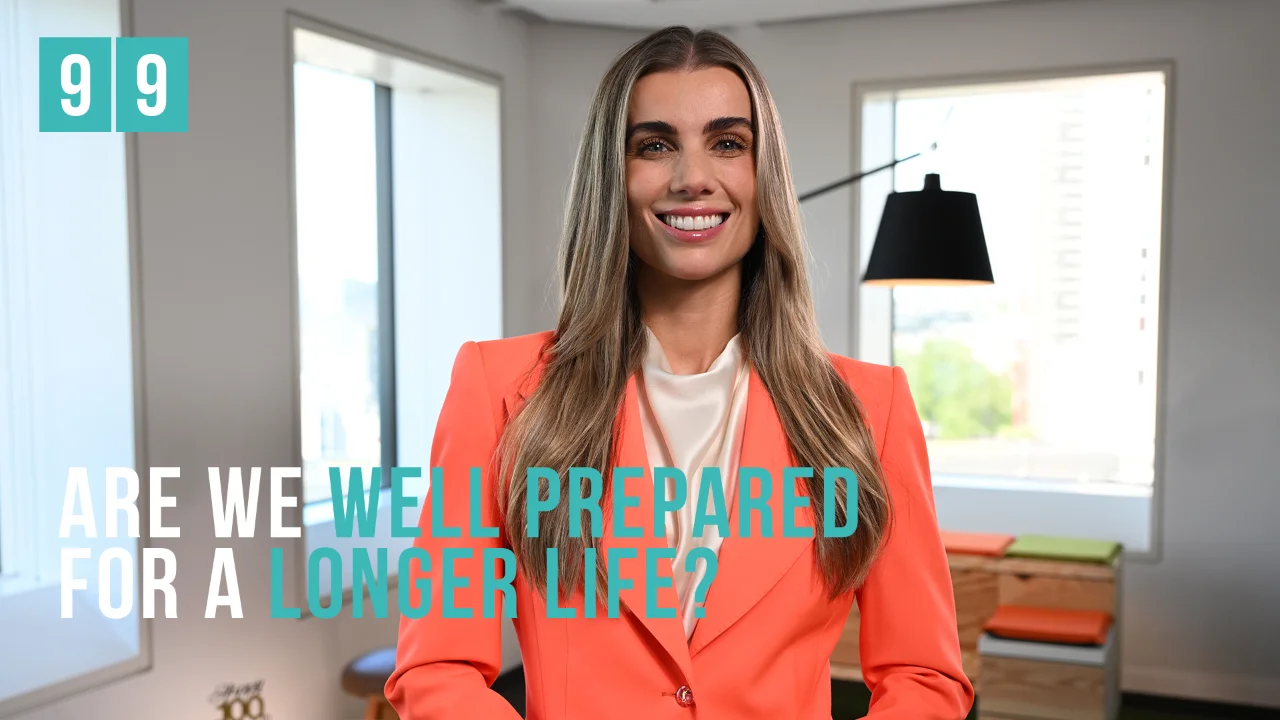
Video: Are we well prepared for a longer life? Explained in 99seconds
What if you live to 100 years – but your money doesn’t? Most people underestimate how long retirement really lasts. It can be 30 or more. As lifespans extend, financial planning has to change. Tune in and watch our latest 99 seconds episode now!
Lisa-Marie, we are living longer than previous generations. What impact does that have on wealth planning?
Longevity is not just about living longer. It also raises a very practical question: how long does my money need to last? In the past, financial planning often focused on education, work, family and retirement. Today, another phase of life is becoming more important: the years after conventional working life, but before what we traditionally think of as old age.
Many people remain active during this phase: they contribute to society, support others, invest more deliberately or take a more hands-on approach to their wealth. At the same time, they may also need to plan for the possibility of a longer period of care later in life.
The planning challenge is therefore clear: how can wealth remain flexible over a longer life? Wealth should fit people’s lives, not the other way round.
Why is this topic so urgent right now?
We are at a turning point because several developments are converging. Life expectancy has risen over the long term, society is ageing and more wealth is being passed on, particularly in western Europe. A significant share of wealth is now held by the 70-plus generation.
At the same time, family structures are becoming more complex. That makes succession planning more demanding. People who wait until they feel there is a clear reason to act often lose valuable time. Good wealth planning needs conversations, clarity and sometimes the courage to ask difficult questions early.

Good wealth planning needs conversations, clarity and sometimes the courage to ask difficult questions early.
What questions do clients ask when they talk about longevity?
Many start with a very personal question: how can I protect my standard of living if retirement lasts much longer than expected? From there, the conversation quickly broadens. Who do I want to provide for? What responsibility do I have towards my family? What should happen to my wealth if I can no longer make decisions myself?
For entrepreneurial families, the picture is even more complex. It is not only about private wealth, but also about responsibility for a company, employees and the next generation. Family wealth, business assets and roles within the family need to be clearly defined. Otherwise, conflicts can arise precisely when quick decisions are needed. That is why the starting point is not a product, but an understanding of the family’s overall situation.
Many people in their 30s, 40s or 50s still feel too young for these questions. What would you say to them?
I would say: that is precisely the right time to start. The earlier people start, the more options they have. Wealth planning is not a one-off appointment for later. It is a process. It should be reviewed regularly because life circumstances, markets, family situations and goals change.
It is similar to health. Many people pay attention to nutrition, exercise and preventive check-ups because they want to age well. A regular financial check-up can be just as useful. It shows whether a plan still fits someone’s life.
Many people still plan for around 20 years of retirement. What is the problem with that assumption?
The problem is that reality is often different. Four in five people over 50 underestimate their average life expectancy.
Four in five people over 50 underestimate their average life expectancy.
If retirement lasts 25 or even 30 years rather than the 20 many people plan for, their income and assets need to stretch much further. Over many years, inflation and the cost of care later in life can erode financial security more than people realise.
Demographic change adds to the pressure on state pension systems. Reform proposals with a stronger capital-market component, as we are currently seeing in Germany, are broadly a step in the right direction. But retirement provision should be built on several pillars.
Our latest survey shows that many people have still not addressed this issue. More than 31 percent of Germans have not yet made any private provision for retirement, while 23 percent have made only limited provision.
Another issue is that many plans are too static. They are drawn up once and then left unchanged for years. But life does not stand still: relationships, families, markets, legal frameworks, health and careers all change.
Retirement planning is not just about pensions. It is about preparing for the different stages of a longer life.
Wealth is not an end in itself. It should help people live on their own terms – today, in retirement and, if they wish, across generations.

(Financial) Planning for a longer life? Three things to keep in mind:
1. Start early. The sooner you begin investing, the more time your money has to grow.
2. Life changes. Your financial plan should too. Check in regularly and adjust when your goals shift.
3. Retirement could last longer than you think. Plan for the years ahead, not just the years until retirement.
This page was published in September 2026

About Lisa-Marie Wöhrle
Lisa-Marie Wöhrle has led Wealth Planning Germany at Deutsche Bank since 2026. In this role, she is building wealth planning into an integral part of the bank’s broader wealth management offering. She also serves as a Supervisory Board Member of Deutsche Oppenheim Family Office AG. She began her career as a specialist advisor for intergenerational wealth planning. At Deutsche Oppenheim Family Office, she was responsible for succession planning, inheritance matters and foundations. Most recently, she headed Wealth Planning at UBS Germany.
Deutsche Bank and wealth planning
Your wealth, your vision – expertly managed. Discover flexible strategies, tailored solutions and global insights to help you invest and manage your wealth with confidence.
Sonja Dammann
… works in Group Communications at Deutsche Bank, focusing on the topics of AI, sustainability and entrepreneurship. She develops storytelling formats, video productions, and campaigns.
Recommended content
Bold Entrepreneurship | Opinion
What if ageing is actually a growth story? What if ageing is actually a growth story?
Pedro Ros reveals why longer lives are creating one of the world’s most underestimated growth markets.
What if ageing is actually a growth story? Explore the Silver Economy
Bold Entrepreneurship | Explainer Video
Living longer starts earlier: why longevity is becoming a megatrend Living longer starts earlier: why longevity is becoming a megatrend
A longer life changes not only how we think about our health; it impacts the way we work, how we spend our money and plan for our financial future. The foundations are laid early.
Living longer starts earlier: why longevity is becoming a megatrend We are living longer — now what?
Bold Entrepreneurship | Opinion
“Adapting to longer lives is as crucial as adapting to AI or climate change” “Adapting to longer lives is as crucial as adapting to AI or climate change”
Longer lives are reshaping economies and careers. Andrew J. Scott explains why the longevity revolution is just getting started.
“Adapting to longer lives is as crucial as adapting to AI or climate change” Why longer lives change everything